Wednesday, April 1, 2015

A Blow to Baseball

Concussions are not as big an issue in baseball as they are in boxing, football or hockey, but they are a problem. Players can collide with a wall or one another on the field or basepaths. Batters can be hit in the head with a pitch, and pitchers with a batted ball. At greatest risk are catchers, whose facemasks are routinely jarred by foul tips. Concussions account for about 2% of time lost, and are increasing at a rate of 14% per year. Although baseball has a seven-day disabled list specifically for concussion victims, there is no universal time off standard. Players can return if they show no symptoms, pass a series of physical and mental tests, and have the approval of the team doctor.

© Getty Images
What makes baseball attractive for study purposes is the fact that individual performance can be quantified easily. A research team head by Jeffrey Bazarian at the University of Rochester compared the performance of 66 position players (non-pitchers) who suffered concussions from 2007 through 2013 on seven offensive metrics: at bats, batting average, on-base percentage, home runs, slugging percentage, OPS (on-base plus slugging percentage), strikeouts and walks. (Of course, these seven measures are not independent.) These data were calculated for the two weeks before the concussion (pre-event), the two weeks immediately after the player's return (post-event), and the period between 4 and 6 weeks after his return (long term post-event). To control for the possibility that performance was changed by time off alone, they computed the same measures for 68 players granted leave for paternity or bereavement. The analysis statistically controlled for position (catcher vs. non-catcher) and number of days off.

The results showed significant immediate post-event declines for concussion victims on four of the measures: batting average, on-base percentage, slugging percentage, and OPS.  Overall, the players coming back from paternity or bereavement leave showed a slight improvement, suggesting there may be some value in mid-season rest. The concussion victims continued to hit more poorly relative to the leave group during the long term post-event period, but the differences were not statistically significant. Here are the means:

Batting Average
Event
Pre-Event
Post-Event
Long Term Post-Event
Concussion
.249
.227
.261
Leave
.255
.271
.269

On-Base Percentage
Event
Pre-Event
Post-Event
Long Term Post-Event
Concussion
.315
.287
.318
Leave
.331
.332
.333

Slugging Percentage
Event
Pre-Event
Post-Event
Long Term Post-Event
Concussion
.393
.347
.398
Leave
.393
.433
.404

OPS (On-Base Plus Slugging)
Event
Pre-Event
Post-Event
Long Term Post-Event
Concussion
.708
.633
.715
Leave
.724
.765
.736

The results suggest that these ballplayers had not fully recovered from their concussions before returning to action. The authors mention several possible explanations for the performance decline, including poorer visual acuity, slower reaction times, and problems with balance. Hitting a baseball thrown at 90 mph from a distance of 60 feet requires optimal performance of all these systems. However, the two measures most clearly associated with “seeing the ball,” strikeouts and walks, did not show significant change. Maybe the batters were hitting the ball at the same rate, but not hitting it as solidly.

I can understand why baseball players feel pressure to return to the field after an injury. The mean salary is slightly over $4 million, a loss to the team of almost $25,000 per game for time spent on the disabled list. This study suggests, however, that keeping the player on the bench longer might benefit not only the player but also the team.

Post Script

When this study was reported in the New York Times, the reporter interviewed Dr. Gary Green, Medical Director for Major League Baseball. The article states:

Dr. Green was . . . unimpressed with the study, which he said had major methodological problems and lacked proper controls. “You really can't draw many conclusions from it. If it shows anything it shows that the batting parameters—strikeouts and walks—are actually fairly consistent before and after injury.”

Green said he felt that there was no way to distinguish the changes the study found from ordinary variations over the course of the season that happens with all players.

There are several problems with Dr. Green's comments. Of course, no one is denying that there are consistent differences between players in batting performance. Since this study is a within-subjects design, one of its strengths is that it permits these individual differences to be statistically eliminated, allowing a more precise estimate of the effects of concussions. It was also disingenuous of Dr. Green to mention only strikeouts and walks, while ignoring the four other performance measures that are likely to be of equal or greater interest to the team management.

More importantly, Dr. Green has a fundamental misunderstanding of the logic of research design. When results are statistically significant, that means they are unlikely to be explained by ordinary variability over the course of the season. For example, if the probability of a result were less than .01, the likelihood of this result occuring by chance is less than one in one hundred. The probabilities of the four results reported in the above four tables were less than .005, .01, .004 and .003, respectively.

In my opinion, a reporter has a responsibility to do more than quote spokespersons on both sides of a controversy when one of them makes erroneous or implausible statements. Letting such remarks go unchallenged is a form of false balancing. The reporter should have pressed Dr. Green to explain what methodological problems he found with the study. He also should have briefly explained the meaning of statistical significance to the reader. If he felt uncomfortable saying these things in his own voice, he could have called one of the authors of the study and asked him or her to respond to Dr. Green.

Of course, this presumes that the reporter knows enough about research design to be skeptical of Dr. Green's remarks.

You may also be interested in reading:


Sunday, March 8, 2015

Snow Job

The corporate media, in their near-saturation coverage of extreme weather events, almost never mention climate change as an important cause of these events. This is documented in a study by Fairness and Accuracy in Reporting (FAIR), which examines news reports about the extreme cold and heavy snowstorms that have hit the Eastern U.S. this year.

FAIR examined the transcripts of all ABC, CBS and NBC network news programs from January 25—the time of the first blizzard—through March 4. There were 417 segments that mentioned extreme cold, snow or ice, but only seven of them (less than 2%) made reference to climate change.

There is a near-consensus among climate scientists that warmer ocean temperatures lead to a greater concentration of moisture in the atmosphere above the oceans, which in turn increases the amount of snowfall during winter storms. Warmer temperatures also can increase snowfall because the greatest amount of snow falls when the temperature is between 28 and 32 degrees Fahrenheit.


There is less consensus about the causes of the extreme cold of the past two winters, but it seems to be related to the polar vortex, a cyclone-like weather pattern that circles around each pole. Less ice and snow cover at the North Pole has weakened the polar vortex, causing cold air masses to drift southward over the Northern Hemisphere.


Attributing winter storms to climate change seems counterintuitive to people who identify it exclusively with global warming. Unfortunately, four news segments were devoted to Senator James Inhofe's (R-OK) misleading stunt of bringing a snowball onto the Senate Floor to mock “global warming.”

A second finding of the FAIR study is that the corporate media gave substantially less coverage to the current drought in the Southwestern U.S. to than snowstorms in the East. There were twelve segments on the drought during the time of the study, and only one of them mentioned climate change.

That increasing temperature might lead to droughts is not at all counterintuitive. All the climate models predict less rainfall in the American Southwest. But unlike blizzards, droughts are “non-events,” which are less likely to attract media attention even thought their consequences may be quite serious.


Why are the networks so reluctant to connect extreme weather to climate change? One possibility is that they see climate change as a partisan political issue. Its mere mention as a cause of some negative event may be seen as liberal bias. But if reality has a liberal bias, this means that less reality will find its way onto the news. A cynic might also point to the networks' concern about alienating the fossil fuel companies upon whose advertising they rely so heavily.

A study by social psychologists at Rutgers University shows that when people have direct experience with extreme weather—in their case, Hurricanes Irene and Sandy—they are more likely to support politicians whose policies are intended to minimize climate change. However, if this message relating extreme weather to climate change is to reach the ubiquitous “low information voter” in time, the media must make these connections early and often. Right now, that's not happening.

Post Script

The one drought report that did mention climate change was an ABC segment which included this depressing example of false balancing.

A new study from Stanford University claims the drought in California is being fueled by human-caused climate change. But some scientists not involved in the study are questioning some of those findings.

Really? How many scientists? Who are they? Are they independent researchers or are they employed by fossil fuel corporations? What are their objections to the Stanford study? Are these objections scientifically valid? We'll never get answers to these questions from the Mouse House. ABC's message is simply the usual misleading claim that "experts disagree" about climate change.

You may also be interested in reading:


Thursday, February 26, 2015

Liberal Bias

A group of conservative psychologists headed by John Chambers has been fighting back against what they perceive as a liberal bias among social psychologists. Their latest paper demonstrates some systematic errors in assessing social mobility in the United States, with liberals making greater errors than conservatives. The authors refer to these errors as “distorted along ideological lines.”

Social mobility refers to the upward or downward movement of individuals between social classes. It is usually measured by comparing different generations within the same family, called intergenerational mobility. If the United States were a land of great economic opportunity, there would be only a modest relationship between people's wealth and that of their parents. However, studies have shown that there is less social mobility in this country than in most other industrial democracies.

Until recently, most scholars believed that social mobility in this country had declined in the last few decades. This was an inference based on the well-established fact that income inequality has increased dramatically since 1980. Since it is known that countries with the greatest inequality have the lowest social mobility, it was presumed that social mobility had been declining as well. However, in 2014, a research group led by Raj Chetty published an extensive study of the intergenerational mobility of Americans born between 1971 and 1993 using income tax data. They found that social mobility has been relatively constant over the time period covered by the study. The authors note that much of the increase in inequality has occurred at the extreme upper end (“the 1%”), which doesn't have much effect on social mobility. 

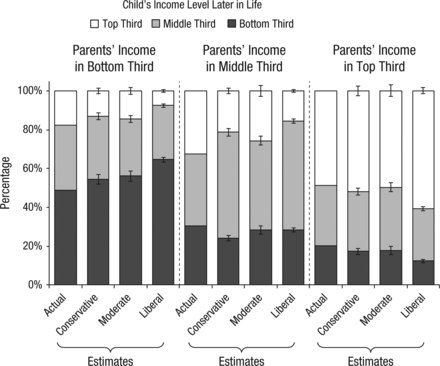
Chambers and his colleagues did an internet survey of 410 American adults in which they were asked to estimate what percentage of Americans born in the early 1980s whose parents were in the top, middle and lower thirds of the income distribution had migrated to each of the other two thirds of the distribution by the time they were in their late twenties. The accuracy of their estimates was measured against the Chetty, et al., data. They were also asked to indicate, on a 5-point scale, whether they thought social mobility had increased, decreased or stayed the same over the past 40 years. Finally, they were asked to state their political idelogy on a 5-point scale running from “strongly liberal” to “strongly conservative.” 

Here are the main findings (which were replicated in a followup study):
  • Most respondents thought there was less social mobility than had actually occurred. Although all three groups underestimated social mobility, liberals underestimated it more than moderates and conservatives did. With regard to people whose parents were in the middle class, liberals underestimated the percentage that were upwardly mobile, while conservatives underestimated the percentage that were downwardly mobile. These findings are illustrated in this chart.


  • The majority (56%) thought that social mobility had declined over the past 40 years, with only 15% answering correctly that it was stable. While the majority in all three groups thought mobility had declined, a higher percentage of liberals gave this incorrect response than moderates or conservatives.
The behavior of the liberals in this study exhibits motivated reasoning. They tend to believe what their ideology tells them, even though in this case it isn't true. Their errors were consistent with the liberal critique of this country that it does not permit enough social mobility. (Conservatives were also guilty of motivated reasoning when the underestimated the percentage of middle class people who were downwardly mobile.)

Some social psychologists and journalists have stated or implied that politically motivated reasoning is more prevalent among conservatives than liberals—the assymetry thesis. Chambers and his colleagues rightly point out that their results contradict the assymetry thesis. It is likely that all people engage in motivated reasoning, the size and direction of their errors depending on the issue at hand. Since liberals favor progressive change while conservatives value the status quo, liberals may exaggerate the seriousness of current problems, such as limited social mobility. Chambers is free to call this “distortion” as long as he applies a similar label to the errors of conservatives.

(Note to researchers: If you want to find “distortion,” it's probably best to present participants with a cognitive task similar to the one used by Chambers—a task that is unfamiliar, and for which everyday life provides little help in arriving at a correct answer.)

Let me tell you what is not the intended take-home message of this post. Just because the public underestimates the amount of social mobility in this country, that does not mean that the current situation is satisfactory. The Horatio Alger myth is still a myth. Miles Corak demonstrated in 2006 that social mobility in the U.S. is substantially lower than in Canada and seven of the eight European countries in the study. Only the U.K. has a (slightly) more rigidly stratified society than the U.S. As one pundit suggested, if you want to live the American dream, move to Finland. Social mobility also varies dramatically by region with the U.S., with mobility being lowest in the southeastern states. (See this PBS interview of Raj Chetty.) Emmanuel Saez, one of the co-authors of the Chetty study, put it this way: “The level of opportunity is alarming, even though it's stable over time.”


Furthermore, the fact that inequality is increasing means that low social mobility has more serious consequences. As the rungs of the economic ladder move further apart, the economic penalty paid by those who are stuck in the middle and lower classes becomes greater. Quoting Saez again, “The consequences of the 'birth lottery'—the parents to whom a child is born—are larger today than in the past.”

You may also be interested in reading:
In Denial

Herding Cats

Is Democracy Possible?  Appendix

Tuesday, February 24, 2015

Our New Family Member, Django

When our beloved dog Chomsky passed away at age 14 in August, we thought it would be a long time before we adopted another. But then Tina found this one-year-old border terrier mix on the internet. He was once scheduled for euthanasia, but was rescued by Tracy's Dogs.


We've named him Django. We think it has a nice ring to it. It also honors jazz guitarist Django Reinhardt; Sergio Corbucci and Franco Nero, writer-director and star of the 1966 film Django; and Quentin Tarantino and Jamie Foxx of Django Unchained. He isn't completely socialized yet, but he's curious and bright and is learning quickly.

The Dirty Dozen(*) of 2014

The reason for the asterisk is the same as my reason for delaying this year's list of best films. I can't remember a year in which I've missed as many critically-acclaimed movies, through a combination of inattentiveness earlier in the year and bad weather during the end-of-year rush. Included among the unseen are American Sniper; Mr. Turner; Only Lovers Left Alive; Selma; Still Alice; The Theory of Everything; Two Days, One Night; and Under the Skin. I'm probably not going to see any of these films for a while, so I'll go with what I have. On the plus side, thanks to Pittsburgh's film festivals, I've managed to include some obscure but excellent films.
  • The Babadook (Australia). A literate haunted house movie and commentary on family dynamics. It's good to have a horror film back in the dirty dozen.
  • Boyhood. You have to admire the risks director Richard Linklater took in shooting a film over 12 years. The consensus choice of film critics, it probably fell short during award season because of its lack of emotional highs and lows.
  • Citizenfour. There's very little technique in this documentary. Laura Poitras simply pointed the camera at Edward Snowden and let Glenn Greenwald interview him. But this is an essential film about the willingness of an individual to stand up against illegal state action.
  • Confession of Murder (Korea). After the statute of limitations expires, a man confesses to murder and becomes an instant celebrity. The detective who conducted the original investigation searches for the truth. Koreans have made some great cop flicks.
  • The Dark Valley (Austria). Although it's set in the snowy mountains of Austria in winter, the film has the plot structure and presentation of a revenge-themed spaghetti Western. Very entertaining genre film.
  • Human Capital (Italy). On the surface, a mystery involving a hit-and-run accident. The facts are filled in as the same events are told from the perspectives of three different characters. The subtext is social inequality in Italy; specifically, the question of how much a human life is worth.
  • Ida (Poland). As beautifully shot in black and white as any film I've seen lately, it has an intriguing premise: In 1962, a young orphan raised in a convent is about to take her vows when she discovers that she's Jewish. But the ending, while probably realistic, was a major disappointment.
  • The Imitation Game (UK). My choice for best film of the year. The central irony is that Alan Turing, who saved the collective British derriere during WWII, was hounded to his death for being gay. Another great performance by Benedict Cumberbatch.


  • A Most Wanted Man. This film of a John Le Carre spy novel involving the hunt for a terrorist went almost unnoticed despite the excellent acting of Philip Seymour Hoffman as a German secret agent.
  • Nightcrawler. Not only does this action movie satirize the sleazy ethics of TV news, the main character (well-played by Jake Gyllenhaal) has internalized the ridiculous self-help messages taught by motivational speakers to naive business students.
  • Stranger by the Lake (France). In this thriller, a man thinks he may have witnessed a murder at a gay swimming place, but he lets his libido overrule his judgment and winds up in real danger. The film is sexually explicit.
  • Unforgiven (Japan). An extremely faithful remake of Clint Eastwood's 1992 film, but the main characters are all samurai. The lead actor is exactly who you'd want in the Eastwood role--Ken Watanabe.
Here are two flawed honorable mentions.
  • Snowpiercer (Korea) has a terrific premise: Runaway global warming, followed by a failed attempt at geoengineering, leaves the survivors stranded on a moving train (“Snowpiercer”) in a below-freezing world. Living arrangements on the train replicate the extreme inequality that preceded the Apocalypse, and the film is about the on-train revolution that follows. Unfortunately, some plot points make little sense, and the film lapses into mindless violence.
  • Whiplash is a well-made, well-acted film with a great soundtrack, but is based on the flawed premise that the way to teach a young man to be a skilled jazz musician is to humiliate him, arousing both anger and fear. Reviews I've read suggest that many otherwise bright people accept this premise, which is not empirically supported.
My take on Birdman is that I agree that Alejandro Inarritu's camera work is outstanding, but I had a hard time identifying with the self-indulgent pseudo-problems of actors under stress. This is one of the world's most overpaid and underworked professions, so spare me, please.

My best actor is Benedict Cumberbatch for the second year in a row (last year, for The Fifth Estate). Best actress goes to Valeria Bruni Tedeschi, the beleaguered upper-class wife in Human Capital.

You may also be interested in reading:

Monday, February 16, 2015

Failures of Memory--Big and Small

By now, we all know that Brian Williams “misremembered” that a helicopter he was in was hit by enemy fire in Iraq twelve years ago. The video below shows how his account of the incident changed over the years. Since the memory was self-serving, many people have characterized Williams' account as a lie rather than an accidental memory lapse. To people who have never been in a war zone, the idea that someone might forget whether his helicopter was hit by gunfire is a pretty tough sell. NBC News implicitly took this position when it punished him by suspending him without pay for six months. Several other well-known people, such as Hillary Clinton, have been caught in similar fabrications, and several of Williams' other recollections have come under suspicion.


Cognitive psychologists point out that the average person dramatically underestimates the malleability of human memory. False memory syndrome refers to cases in which people have an important memory that they truly believe, but which is factually incorrect. Some people have been convicted of crimes they did not commit, such as sexual abuse of children, on the basis of memories “recovered” by alleged victims, usually with the aid of mental health practitioners. Other innocent defendants have been convicted of crimes to which they confessed under police interrogation, and of which they believed they were guilty, at least for a time. A new study by Julia Shaw and Stephen Porter provides some of the best evidence yet for the construction of detailed and important false memories.

The authors used a paradign developed by Elizabeth Loftus for her “lost in a shopping mall” study, in which some college students were induced to develop this false memory. After 126 Canadian students had volunteered to participate in the study, their parents or primary caregivers were interviewed. The purpose of the interview was to identify one highly emotional event of a non-criminal nature that had occurred to the students during their adolescence, and to ascertain that they had never been arrested and charged with a crime. The first 60 students who met these criteria participated in a series of three interviews, each about one week apart.

In the first interview, they were asked to recall and describe the true event and a false event allegedly reported by their parents. In half the cases, the false event was that they were arrested and charged with a crime—ten cases each of assault, assault with a weapon, and theft. The other thirty false events were non-criminal: an accidental injury, being attacked by a dog, and losing a large amount of money. Since none of the participants reported remembering the false event during the first interview, they were given false contextual cues, were asked to try to recover the memory, and were given advice as to how to recover it. They were asked again to describe both events and answer several questions about them during the second and third interviews. At the end of the third interview, they were fully debriefed.

Participants were said to have accepted the false memory if they met two criteria: (1) they reported ten or more details of the incident not suggested by the interviewer, and (2) they reported during the debriefing that they truly believed the event had occurred. Forty-four of sixty participants (73%) met these criteria. The percentages did not differ very much among the six types of false events.

The researchers were impressed not only by the large number of participants who accepted the false memory but also by their “richly detailed” descriptions of it. They compared responses to the true and false memories among the 44 participants who experienced the false memory. These students recalled more details of the true memory (92, on average) than the false memory (72)—but 72 details is still fairly impressive for a false memory. They had greater confidence in the true memory, and experienced it as more vivid, but the amount of anxiety generated by the true and false memories did not differ.

There are some important differences between Brian Williams' false memory and those created in the Shaw and Porter study. As far as we know, Williams' memory was not prompted by anyone else. However, Loftus has suggested that he might have been influenced by “audience tuning.” To paraphrase Jon Stewart, audience responses to his tale might have excited the pleasure centers in his brain and caused his story to drift toward greater bravery over time. In addition, the memories created in the study were not self-serving. Just the opposite. They remembered being charged with a crime. Would their misremembering have been even greater if the memory had been flattering to them?


Leslie Savan expressed her satisfaction that at least someone is being punished for lying about our invasion of Iraq, even if it's not one of the right people. Others have spoken about the relative unimportance of Brian Williams' battlefield exaggeration when compared to the many other lies he routinely told on behalf of the government and his corporate sponsors every weekday night. In fact, we might speculate that NBC's main reason for suspending him was not that he told a false story but his loss of credibility, which might adversely affect public acceptance of their nightly propaganda report.

Pittsburgh Post-Gazette columnist Tony Norman reports that he was in the Monroeville Mall last week when three people were shot, although he didn't see or hear the incident. When he posted his experience on Twitter, one person wryly commented, “in five years, he will say he was shot.”

By the way, did I ever tell you about the time I rescued a dog from a burning building?

You may also be interested in reading:


Sunday, February 8, 2015

IUP's Tuition Increase, Part 2

This post speculates about the possible effects of changes in tuition at IUP. Before reading it, please read Part 1.

You could argue that, were it not for the stealth tuition increase, charging students per credit is a good policy. It is fairer to students who for various reasons, such as needing to work part-time, can only take 12 credits per semester, since they will only be charged for courses they actually take. It also will discourage students from dropping courses. IUP allows students to withdraw from courses without penalty until two-thirds of the way through the semester. Students sometimes sign up for more courses than they expect to complete, knowing they can drop one or two of them if they are having difficulty or just don't like them. This is a poor use of the university's resources. However, assuming there is no refund for courses dropped late in the semester, students and their parents will come to see course withdrawals as a tangible waste of money.

On a less positive note, I can't help but wonder if accustoming students to paying by the credit and eroding the distinction between part- and full-time students isn't also intended to make it easier to shift courses out of the classroom and into what is optimistically called “distance learning.”

According to IUP spokesperson Michelle Fryling, they believe this package of changes will not harm enrollment or retention and could lead to more credit hours being taken. Until pigs master the art of flight, it's hard to see how these claims could possibly be true. In the real world, increasing the cost of an IUP degree by 25% seems almost certain to reduce enrollment.

He's pissed.
In addition, it would seem that charging students by the credit, while simultaneously increasing the cost per credit, will result in students taking fewer, not more, credits per semester. Students will only enroll in the number of courses they can afford. One of the consequences will be that it will take them longer to graduate. For IUP, this means that its four-year graduation rate—an important metric by which universities are compared and evaluated—will decline. For the student, a longer college career means higher room and board costs and lower lifetime earnings.

It is also likely that, when paying by the credit, more students will try to graduate with exactly the required 120 credits and no more. At present, many students finish with more than 120 credits for several reasons. They may change majors. The longer they wait to do this, the more additional credits they have to take. Students also accumulate excess credits if they try to improve their job prospects by taking a double major, or a single major and two minors. Finally, some students take more than 120 credits out of intellectual curiosity, since under the current system, they can take as many as 144 credits in eight semesters at no additional cost for tuition. The new system will make these deviations from the standard path more expensive.

Why are these drastic—and risky—changes being made right now? IUP faces a potential cumulative deficit of $12.2 million by 2015-16, $16.7 million by 2016-17, and $19.7 million by 2017-18. The official line is that enrollment is declining because fewer young people are graduating from western Pennsylvania high schools. This is true, although an “excellent” university might be able to overcome this handicap. However, there are two other problems.

When I came to IUP in 1971, faculty morale was high and there was considerable optimism about the future. We were led to believe that the mission of the state-owned universities was to bring higher education to middle and lower class young people who were usually the first generation in their family to attend college. To this end, the state paid approximately 70% of the cost of a student's education, with most of the remainder being covered by tuition.

In 2014-15, the State System of Higher Education (SSHE) received $412.8 million from the state, which covers only about 25% of its operating budget. Almost all the rest comes from tuition. The change has been gradual, with the exception of an 18% cut in state aid in 2011-12 after Tom Corbett was elected governor. Like the frog in the pan of water whose temperature is gradually increased, many of us failed to notice how these tuition increases were changing student demographics and causing the university to abandon the goal of reducing inequality. Most middle class students who attend IUP now graduate with crushing debt. Pennsylvania ranks 47th among the 50 states in support for higher education. Maybe our state's politicians and their corporate donors have concluded that it's not in their interest that Pennsylvania have an educated population.

The situation is complicated by financial mismanagement at IUP. The university owes $34 million that it borrowed in 2010 to complete the Kovalchick Convention and Athletic Complex, which was built even though insufficient funds had been raised. This is one of several recent projects in which IUP, like some of the other SSHE universities, seemed to place a higher priority on student recreation and entertainment than on education.

Will there be any organized resistance to these changes? The president of the IUP faculty union, Mark Staszkiewicz, is actually a former member of the administration. His comment, “If the state doesn't do something, there's not many options we have,” seems to indicate passive acceptance and little empathy with students. It has also proven frustratingly difficult in the past to overcome student apathy. Of course, the various “discounts” and offers of financial aid are intended to minimize student outrage. 

If both enrollment and the number of credits taken by each student decline, IUP could go into something resembling a death spiral. Program cuts and faculty layoffs could easily follow. Right now, IUP's future does not look particularly bright.   

You may also be interested in reading:

IUP's Tuition Increase, Part 1

Update (2/23/15)

A friend sent me this blog post on the same subject from Kevin Mahoney, a Kutztown University of Pennsylvania faculty member. Dr. Mahoney included the chart below, which I had looked for but couldn't locate, showing both the changes in SSHE's state appropriation and its tuition between 1983 and the present. You'll seldom find a more perfect negative correlation.


Update (4/19/13)

IUP has postponed its decision to charge for tuition by the credit, and the accompanying fee schedule, for one year.

Last week, the Board of Governors of the State System of Higher Education voted, 9-8, to freeze tuition at the 14 state-owned universities next year, provided they receive the $45.3 million (11%) increase in their state appropriation contained in Governor Tom Wolf's 2015 budget. The closeness of the vote reflects the fact that some board members objected to the way in which it seemed to enlist them, along with students and their parents, as supporters of the Governor's budget.

IUP's postponement is a tacit admission that the changes it had planned were a tuition increase, and therefore contrary to the board's new policy. Given the fact that Governor Wolf faces stiff opposition from the Republican majorities in both houses of the legislature, it seems unlikely that he will be able to deliver the full $45.3 million. However, by the time that outcome is known, it will probably be too late for IUP to change its plans again.