Saturday, March 31, 2012

Unrealistic Optimism

Yesterday, I received an email that linked to 29 different op-ed articles, some by politically astute folks like E. J. Dionne, Robert Reich and Eugene Robinson. All of them suggested that if the Supremes rule the Affordable Care Act (ACA) unconstitutional, this opens up an opportunity to pass single payer health care legislation, since it is a better solution to many of the problems the ACA was intended to address, and it is clearly constitutional. Some of them referred to passage of single payer as “inevitable,” although, to be fair, some of them also called it a “long-term” solution to the health care crisis.

If you read my post on this week's events at the Supreme Court, you know that I'm seriously out of step with these political heavy hitters. We all enjoy reading optimistic articles, but as much as I hope they're right, I'm afraid these authors are more engaged in wishful thinking than the realistic prediction of future events.

Apparently MSNBC commentator Chris Hayes read some of these same op-eds. This morning, on Up with Chris Hayes, he asked Senator Sheldon Whitehouse, Jackass from Rhode Island, if he could foresee any “plausible scenario” by which rejection of the ACA might lead to the passage of single payer. Whitehouse's answer was an unequivocal no. He pointed out that this week the House refused to pass even a seemingly non-controversial highway transportation bill that he said would have created three million jobs.

These optimistic-eds seem to overlook the campaign financing, lobbying and advertising power of the “corporate persons” that us sell health insurance. Not only is single payer rejected by 100% of the Elephants, it is opposed by President Obama and a majority of the Jackasses as well.

When a major health care reform initiative has failed in this country, it has taken a long time for someone to try again. It was almost 20 years between the failure of the Clintons' reform proposal and the passage of the ACA. As we're all learning, just because we have a serious problem in this country, that doesn't mean our government will try to solve it. Every year, 45,000 Americans lose their lives due to lack of or inadequate health insurance. Very few of these people contribute to political campaigns.  As Ezra Klein, one of those "optimists" who sees single-payer only as a distant possibility, states:

The key word here is “eventually.” This is a long, ugly process that ensures a very large uninsured population for decades. . . [I]n the decades between here and there, there will be a lot of unnecessary suffering and deaths among the uninsured. That's the real cost of losing this opportunity to insure 30 million people.  

If you're hoping the Supremes strike down the ACA, be careful what you wish for.

Thursday, March 29, 2012

Protecting the Parasites: The Irony of Obamacare

Earlier this month, the Green Party called on the Supremes to strike down the individual mandate and put an end to the Affordable Care Act (ACA). Their argument is that the ACA is merely a multibillion dollar public subsidy for the insurance, pharmaceutical and medical industries. This is certainly true. But they go on to predict that if the ACA were declared unconstitutional, this would hasten the passage of a single payer, or Medicare for All (as they call it), health care system. (The usually astute economist Robert Reich has made a similar argument.)

As much as I sympathize with their goals, I find that hard to believe that a single payer health care system will make its way through Congress in the near future, even in the unlikely event that a re-elected President Obama were to support it. If he didn't have the votes to support even a public option in early 2010, when the Jackasses controlled the House and had a veto-proof majority in the Senate, what are his chances of passing an all public system in 2013? And how will an overturning of the act by the Supremes affect Obama's chances of re-election? Are you ready for the endless barrage of super PAC-financed TV ads reminding voters that Obama's “signature accomplishment” has been rejected by the courts?

The public also wants the ACA to be overturned. According to a New York Times poll, 29% want the Supremes to overturn the individual mandate, which requires all Americans to purchase health insurance, and another 38% want them to overturn the entire law. After three days of debate, it looks as though they will get their wish. This morning's Washington Post reports that the Supremes “may be on the brink of a major redefinition of the federal government's power.”

Justices on the right of the deeply divided court appear at least open to declaring the heart of the overhaul unconstitutional, voiding the rest of the 2,700-page law and even scrapping the underpinnings of Medicaid, a federal-state partnership that has existed for nearly 50 years.

Of course, you can never predict the Supremes' decision solely on the basis of oral arguments. But if you doubt that they are seriously considering it, remember that they spent 1.5 hours Wednesday discussing what should happen to the rest of the ACA if—or is it when?—the individual mandate is overturned.

This is not a game. With all its flaws, the ACA extends health insurance to 32 million people not previously covered. Without that coverage, we return to a status quo in which 45,000 Americans die every year from lack of health insurance. The Elephants don't have an alternative plan. Their plan B is to “let them die.”

I can point you to a serious article giving at least three constitutional bases for the ACA, but in fact, it's a no-brainer. John Cassidy has referred to this legal case as a “bad joke.” Robert Parry refers to the justices as “clowns.” Who could possibly believe that Congress has no right under the Commerce Clause to regulate the health care, an industry which accounts for 17.6% of GDP? In 2005, Justice Scalia wrote a concurring opinion in Gonzales v. Raich, in which argued he that the Commerce Clause gave government the right to prohibit the sale of medical marijuana. I don't know what percentage of the nation's health care dollars are spent on medical marijuana. Let's say it's about one-tenth of 1%. Are the conservative justices saying that the sale of medical marijuana is important enough to affect interstate commerce, but the entire health care industry is not? Seriously?!?  It's hard to see this as anything but a farce.

In my opinion, all the verbal jousting going on this week is intended to mystify the public and give judicial cover to the five conservative justices, so they can do what they intended all along: Help the Elephant Party to ensure that Barack Obama will be a one-term president whose four years in office are remembered as a failure. This should not be unexpected. Previous lineups of the Supremes have already allowed politics to trump both the Constitution and legal precedent.

This brings us to the Supreme irony of Obamacare. It appears that the ACA will be destroyed by the individual mandate—an Elephant proposal that Obama was initially reluctant to accept, and that he agreed to in order to save our privatized health care system from the threat of single payer.

During the 2008 campaign, Obama opposed the individual mandate, which Hilary Clinton supported, because he knew it would be perceived as a restriction of individual freedom and there would be a backlash. Why did Obama eventually agree to include something as unpopular as the individual mandate? Basically, it was to save the private health insurance companies.

Insurance companies make money by covering healthy people and denying coverage to those who are sick—or refusing to pay the medical bills of their clients who get sick. That means that in this country, if you develop a serious illness, you are for all practical purposes uninsurable. Americans in this unfortunate situation either become dependent on some sort of public program, die sooner than they otherwise would, or both.

To avoid this, you could require the insurance companies to insure everyone (called guaranteed issue). But if they are forced to cover sick people, they will charge them an amount that most of them can't afford. To avoid this, you could require the insurance companies to charge everyone the same amount regardless of their prior medical history (called community rating). But if you have both guaranteed issue and community rating, there is no logical reason for healthy people to purchase insurance. They can simply wait until they get sick, confident that the insurance companies will have to cover them at an affordable rate. This is known as adverse selection—the tendency for people who buy health insurance voluntarily to be less healthy than the general population. This causes insurance company profits to go down, rates to go up for everyone, and eventually the entire system descends into chaos. To avoid this, you have to require everyone to buy insurance—the individual mandate. This ensures that there are enough healthy people in the system to spread the risk and make insurance affordable for all.

But there's another way. You could simply bypass the insurance companies. Collect the money that people would otherwise pay for insurance premiums up front as taxes and use it to insure everyone. In other words, you could establish a single payer system. This is how social security and Medicare are financed. It would be politically difficult to argue that they are unconstitutional (although some of the arguments currently being advanced against the individual mandate imply that they are).

This irony at the heart of Obama's dilemma was not lost on at least one of the Supremes, Justice Ruth Ginsberg, who noted on Tuesday that:

There's something very odd about that, that the government can take over the whole thing and we all say, oh, yes, that's fine, but if the government wants to preserve private insurance, it can't do that.

Of course, single payer would eliminate the health insurance business. But that's exactly what we should do! Health insurance consumes about 20% of medical spending and provides no useful service in return. It's a giant parasite that sucks up our resources, even as it adds additional misery to the lives of some of our sickest citizens. Eliminating that 20% surcharge virtually guarantees that the extra amount people pay in taxes for single payer will be less than they are currently paying for health insurance.

(That's not the only way single payer will save money. Single payer will give the government the bargaining power to negotiate lower prices for prescription drugs and to rein in the exhorbitant fees paid to doctors and hospitals. Needless to say, big pharma and the for-profit hospitals oppose it too.)

So why couldn't Obama propose a single payer health care system? As the media put it, single payer was “not politically feasible.” That's media-speak for a proposal that is favored by the majority of the American people, but opposed by the “corporate persons” who finance our political campaigns. And in a political system that's basically just legalized bribery, those who finance the campaigns are the only ones who really matter. The richest 1% not only bought and paid for Obama, but most of Congress as well. Had he proposed single payer, he would have faced opposition not only from the Elephants but also from the majority of his fellow Jackasses.


The individual mandate was a conservative idea that President Barack Obama adopted to preserve the private market in health insurance rather than move toward a government-financed single-payer system. What he got back from conservatives was not gratitude but charges of socialism—for adopting their own proposal.

No matter how often he kisses their behinds, the 1% will never accept the legitimacy of Obama's presidency.

Give some credit to the conservative propaganda apparatus. They have successfully framed the individual mandate, the central issue of the debate, as an attack on personal freedom. “The government is trying to force you to buy health insurance.” This is reinforced by a series of wildly implausible slippery slope arguments. “If the government can force you to buy health insurance, then it can also force you to buy broccoli, or a cell phone, or gay pornography!” (Naturally, such proposals are likely to sail through Congress with little dissent.) An American public that lacks the ability or motivation to think critically appears to be buying into this fallacy.
I think Slate's Dahlia Lithwick nailed it when she pointed out that, “This case isn't so much about freedom from government-mandated broccoli or gyms. It's about freedom from our obligations to one another. . . It's about freedom to ignore the injured, walk away from those in peril. . . It's about the freedom to be left alone.”

During Tuesday's oral argument, Solicitor General Donald Verilli argued that health care is different from other markets because we don't just let sick people die. “(G)etting health care service,” he said, “[is] a result of the social norms to which we have obligated ourselves so that people get health care.”

To which Justice Scalia replied, “Well, don't obligate yourself to that.”

Wednesday, March 28, 2012

Open Carry

Last week, in connection of the shooting death of Trayvon Martin by George Zimmerman, I posted research showing that people are more likely to “see” a gun in the hands of a African-American man than a white man, even when that black man is carrying a harmless object such as a cell phone. Now I've found a new series of studies that suggest that carrying a gun also increases the likelihood that you will see a similar weapon in the hands of others.

Photo by itwuzcryptic
In a soon-to-be-published paper, Jessica Witt and James Brockmole of Notre Dame University report five studies in which they asked student participants to look at slides of men carrying either guns or harmless objects. The students had about a half-second to indicate whether the person was armed or not by raising or lowering a lever. The experiment varied the handle of that lever. In one condition, it was shaped like a realistic-looking toy handgun. It the other, it was a rubber ball. The results showed that the participants were more likely to “see” the person in the slide as holding a gun when they themselves were holding a gun than when they were holding a ball.

The authors interpret these findings as consistent with the theory of event coding. This theory is a scientific variation on the old saying that when you're holding a hammer, everything looks like a nail. When planning an action with an object or tool, you are predisposed to identify other objects on which the tool might be used.

The authors also considered the theory of conceptual priming. This theory suggests that the mere presence of a weapon in the environment predisposes people to “see” other weapons. They rule this explanation out due to one of their five experiments. In this variation, a real firearm was placed on the table while the subjects were performing the task using the lever with the rubber ball handle. There was no greater tendency to see the man in the slide as holding a firearm when a real gun was present in their environment than when it was not.

I suspect that they ruled out the priming explanation prematurely. First of all, there are other studies showing that aggressive cues in the environment affect behavior. For example, in a study by Berkowitz and LePage, frustrated participants were more likely to respond aggressively when there were weapons (a handgun and a rifle) on the table than when there was either a neutral object (a badminton racquet) or nothing on the table. Secondly, in the Witt and Brockmole study, participants were exposed to many photos of handguns, and guns were referred to when explaining the task. It's possible that in such a gun-saturated environment, the presence of yet another gun—albeit a real one—didn't make much difference.

I go into these details not only because I believe in priming—an effect supported by literally thousands of studies. It also affects the practical implications of Witt and Brockmole studies. A strict interpretation of them would state that the bias to “see” a gun occurs only when you are holding a gun in your hand.

In this country, all but eight states permit ordinary people to openly carry a firearm either on their person or in their car (although some of them require a license), and all but Illinois (and D. C.) allow people to carry concealed weapons. This research implies that carrying a firearm makes you more likely to see others as dangerous. Does it matter whether you are carrying the gun in your hand, in a holster, or in the glove compartment of your car? Probably. You are more likely to be aware of the gun when it's in your hand (as Zimmerman's apparently was). But I suspect that carrying a concealed weapon alters threat perception as well. Maybe future studies will test the limits of this effect.

Thursday, March 22, 2012

The Ultimate Attribution Error

In his excellent blog, Glenn Greenwald made the following point about media coverage of the massacre of Afghan civilians by an American soldier:

Here's a summary of the Western media discussion of what motivated U. S. Staff Sgt. Robert Bales to allegedly kill 16 Afghans, including 9 children: he was drunk, he was experiencing financial stress, he was passed over for a promotion, he had a traumatic brain injury, he had marital problems, he suffered from the stresses of four tours of duty, he “saw his buddy's leg blown off the day before the massacre,” etc.

Here's a summary of the Western media discussion of what motivates Muslims to kill Americans: they are primitive, fanatically religious, hateful terrorists.

Greenwald also points out that when the media try to understand possible causes of the bad actions of American soldiers, we don't confuse them with excuses for their actions. But when anyone suggests that Afghans who commit crimes may be responding to the illegal and increasingly violent occupation of their country, they are immediately accused of attempting to justify or defend terrorism.

This illustrates what social psychologist Thomas Pettigrew called the ultimate attribution error. Attribution refers to the process of identifying the causes of events. Humans are known to make a number of systematic errors when assigning causality. The ultimate attribution error refers to a systematic bias in the way we analyze the behavior of ingroups vs. outgroups, or friends vs. enemies. Good and successful actions by ingroup members are attributed to their stable internal dispositions, such as ability or motivation. But our own and our friends' bad or unsuccessful behavior is seen as a temporary product of a difficult situation or environment.

When analyzing the behavior of an outgroup, especially a disliked one, this tendency is reversed. Their bad behavior is seen as a product of their evil nature, while their good behavior is a product of a temporary, favorable, external situation. (Think of the tendency of prejudiced whites to attribute black success to affirmative action.) Needless to say, any unfavorable stereotypes we have of outgroup members will be maintained by these attributions, even in the face of behavior that might appear to contradict them.

Greenwald's point reminded me of a pair of related studies by Michael Morris and Kaiping Peng. In the first, they analyzed newspaper accounts in the New York Times and the Chinese-language World Journal of two mass murders that occurred in the United States, one committed by a Chinese man and the other by an American man. Each unit, or clause, that gave an explanation for the crime was classified according to whether it referred to a permanent disposition of the actor or a temporary situational influence.

The Times article showed the ultimate attribution error. American reporters attributed more causality to situational factors when describing the American murderer than the Chinese murderer. On the other hand, more dispositional traits were attributed to the Chinese than to the American killer. The Chinese-language newspaper did not show this bias.

The second study was an experiment. Chinese and American participants were given an article about either the American or the Chinese murderer to read. The articles were balanced in that they referred to an equal number of personal and situational causes of the crime. Afterwards, the participants were asked to rate the importance of the personal and situational explanations mentioned to in the article. As predicted, the American participants gave more weight to dispositional factors when rating the Chinese than the American murderer, and more weight to situational factors when rating the American than the Chinese killer. The Chinese participants did not show this bias.

This is a relatively conservative test of the ultimate attribution error, since there was no particular reason to think the American participants were hostile to individual Chinese citizens. In this study, the Chinese are an outgroup rather than an enemy. You would expect the contrast to be greater when we are at war with the outgroup.

The study shows that the ultimate attribution error occurs both in our individual judgments and in the mass media, but it doesn't address the chicken vs. egg problem. Do the media influence our judgments, do they pander to what they know are our preferences, or both?

Finally, you'll notice that in this study the ultimate attribution error is uniquely characteristic of Americans. I hope to discuss how and why Americans' attributions differ from those of most of the rest of the world's people in a future post.

Breathing While Black

Beginning ten years ago, social psychologists did a series of studies looking at the consequences of our cultural stereotypes about African-American men and violence. A study by Joshua Corell and others called “The Police Officer's Dilemma” is typical. White participants were shown slides of young men standing in public places, such as a park or a city sidewalk. Half of the pictures were of black men and half of white men. Within each racial group, half of the men were holding handguns and the others were holding some innocuous object, such as a cell phone or a soda can. The participants had a half-second to press one of two keys labeled “shoot” or “don't shoot.” The researchers counted the number of errors—either not shooting an armed man or shooting an unarmed man.

The results showed evidence of bias. When the men in the photos were white, the participants made the same number of errors regardless of whether the men were armed or not. However, when the men were black, they made fewer errors when they were holding a gun, and more errors when they were not. In other words, they were more likely to “shoot” a black man than a white man, both when he was armed and when he was not.

This is an example of automatic or fast thinking, which Kahneman calls “a machine for jumping to conclusions.” Subsequent research showed that the results did not vary with personal prejudice. However, the participants showed a greater “shooter bias” when they were more aware of the cultural stereotype, that is, when they gave higher estimates of the percentage of Americans who saw black men as aggressive, dangerous and violent. Exposure to newspaper articles about black criminals also increases the size of the shooter bias.

The fact that this response tendency is automatic doesn't mean it can't be controlled. The shooter bias can be reduced through practice and with certain kinds of training, such as instructing participants to ignore the race of the person in the photo and to concentrate on the presence or absence of a gun.

This series of three videos (about 35 minutes total) featuring social psychologist Jennifer Eberhardt deals with primarily unconscious racial biases. The study on weapons stereotypes is in the second segment, but I recommend them all. (You Tube will guide you through them.) Some of them are shocking, and will make it clear why social psychologists are unwilling to accept mass media assurances that prejudice is a thing of the past.


I think these studies are relevant to the killing of unarmed black teenager Trayvon Martin by Florida neighborhood watch volunteer George Zimmerman. Zimmerman says he felt threatened by Martin, and so far, the Sanford, FL police have accepted his claim that he acted in self defense. This defense is made possible by Florida's 2005 “stand your ground” law, which was written by the National Rifle Association. Variants of which have been enacted in 20 other states. The relevant section of the law reads as follows:

A person who is not engaged in an unlawful activity and who is attacked in any other place he or she has a right to be has no duty to retreat and has the right to stand his or her ground and meet force with force, including deadly force, if he or she reasonably believes it is necessary to do so to prevent death or great bodily harm to himself or herself or another or to prevent the commission of a forcible felony.

This law does away with the longstanding legal doctrine that, when outside your home, there is a “duty to retreat” when confronted with a dangerous situation. It creates ambiguity about when a person is acting in self-defense. How can it be objectively determined that a person “reasonably believes” he or she is threatened? The studies of shooter bias suggest that people might sincerely believe themselves to be in danger when confronted with an unarmed black man. Even if the perpetrator is wrong, he or she may escape punishment if the mistake is “reasonable.”

The difficulty is compounded when there are no witnesses or the witnesses are friendly to the perpetrator. Who is able to contradict the shooter's self-report of his or her emotional state? Not the victim. He's dead. As a result, police and prosecutors may assume that they have little chance of obtaining a conviction in a jury trial.

From reading the accounts or this incident and listening to the 911 tape (see below), I doubt whether Zimmerman sincerely felt himself to be threatened. He pursued Martin even after the police told him not to. However, the reference in the law to “prevent(ing) the commission of a forcible felony” seems to encourage this type of vigilantism. When combined with Florida's lax gun laws, the “stand your ground” law allows armed, aggressive, and possibly paranoid people to pursue their fantasies of law enforcement and justify their behavior with after-the-fact claims of self-defense.


Justifiable homicides in Florida have tripled since the law went into effect. In 93 cases in which the defendant claimed self-defense under the new law, charges were dropped in 57 of them, and 7 others were acquitted by a jury. This law is irresponsible and should be repealed. If the shooter bias studies are to be taken seriously, the equal protection claise of the Fourteenth Amendment would seem to provide a basis for overturning them.

Tuesday, March 20, 2012

Reality Shows a Slight Gain

It's the first day of Spring in Pittsburgh, and a high of 80 degrees is predicted. Our magnolia tree is blooming a month ahead of schedule. Temperatures have been well above normal all winter—11.6 degrees so far this month. I would never cite any of this as evidence for global warming. This is weather, not climate. Yet for most Americans, this may be the most convincing evidence.

Photo by tumbleweed@yahoo.com

The sixth and latest National Survey of Public Opinion on Climate Change was conducted in December, 2011 by Christopher Borick of Muhlenberg College and Barry Rabe of the University of Michigan. It was a telephone survey with 887 respondents and a margin of error of +/-3.5%.

The good news is that belief in global warming seems to be on the rebound. In Fall 2008, 72% of Americans believed “there is solid evidence that the average temperature on Earth has been getting warmer.” This number dropped to 52% by Spring 2010. Since then, it has gradually increased and now stands at 62%. 26% say “no,” and 12% are “not sure.”


The survey finds the usual effect of political partisanship. (See table below.) The other three demographics they looked at—gender, race and education—had no effect. Yes, that's right, teachers, education has no effect!


Earth Getting Warmer
Earth Not Getting Warmer
Not Sure
Democrats
78%
15%
7%
Republicans
47%
42%
11%
Independents
55%
30%
15%

Respondents who thought the Earth is getting warmer were asked the primary reason for their belief (out of nine possibilities that were suggested to them). It was a tie. 24% cited their personal experience of warmer temperatures, and another 24% said it was the presence of extreme or changing weather (floods, droughts, tornadoes, etc.) that convinced them. Therefore, almost half the respondents who believe climate change is real base their belief on the weather. Only 8% chose scientific research as their main reason for thinking the Earth is getting warmer.

The problem, of course, is that people are not distinguishing between weather and climate. Weather is far more variable. What randomness gives, it can also take away. Next year, when temperatures in the Northeast regress toward the mean—as they inevitably will—residents may again reduce their belief in global warming. (The authors point out that more people claim warm weather as evidence of climate change when their surveys are conducted in the Fall than in the Spring.) If we have to wait until a high percentage of Americans are convinced by the weather that global warming is real, we may fail to take action in time to save ourselves.

Finally, respondents were asked whether they thought “the media is (sic) overstating the evidence about global warming” and whether “scientists are overstating evidence about global warming for their own interests.” (Italics mine.) Not surprisingly, people who did not believe in global warming thought they were being lied to. 90% thought the media were overstating the evidence and 81% thought the scientists were.

I'm curious about the thinking that went into the wording of these two questions. Why are scientists presumed to have “an interest” in the outcome of global warming while the media are not? I wonder how much people think climate scientists are paid, whether they think scientists' salaries are contingent on finding evidence of global warming, and, if so, who is paying them this extra money. How does this compare to the incentive the media have for understating the evidence—namely, the millions of dollars they make from fossil fuel advertising?

The article does not report whether respondents attribute climate change to human activity. However, the authors promise a follow-up article looking at policy implications of the survey, so we may learn the answer to that question later.

Thursday, March 15, 2012

Occupy the Tax Code

There is a substantial literature in social psychology relating both income and income inequality to happiness. In summary:
  • Relative income is important. In all societies, there is a positive association between personal income and happiness. That is, the rich are happier than the poor.
  • When comparing relatively affluent countries, the most important variable affecting happiness at the societal level is income inequality. The greater the difference in income between the rich and the poor, the less happy the people in that society are.
In view of the importance of inequality and its relevance to the Occupy Movement, I'm going to post a series of articles summarizing this research and its implications, probably beginning next week. However, the current post is about a new study looking at one of the ways to reduce inequality—progressive taxation.

First, let's be clear about terms.
  • A progressive tax system is one in which as income goes up, the tax rate increases. Our income taxes are, in theory, progressive. The rate varies from 15% to 35%. However, the fact that capital gains are taxed at a lower rate than other income and the existence of various loopholes make the system less progressive than it otherwise would be.
  • A regressive tax is one in which the poor pay a higher tax rate than the rich. Sales taxes are regressive, since low income people spend a higher percentage of their income.
  • A flat tax is one in which everyone pays the same rate. Everyone enrolled in Medicare pays the same rate (1.45%) regardless of their income.
One way to reduce income inequality is through progressive taxation. The rich are taxed at a higher rate, and some of that money is redistributed either in the form of direct payments to the poor (welfare), or through public goods such as education, health care, or public transportation. Oishi, Schimmack and Diener looked at the effect that progressive taxation has on the general level of happiness among countries. Since they were looking only at progressive taxation, they statistically eliminated the effects of average income, income inequality, the average tax rate, and government spending. (In case you are wondering, average income is positively related to happiness, inequality is negatively related, and both the average tax rate and government spending are mostly unrelated.)

Happiness data were collected from 54 countries by the 2007 Gallup World Poll. It was measured in three ways. Global life evaluation asked people to rate their life on a 10-point scale from worst to best possible life. Positive life experiences refers to the average answer to ten questions about yesterday, such as whether the participants smiled or laughed a lot, or were treated with respect. Negative life experiences is the average answer to seven questions about whether they experienced negative emotions, such as sadness or anger, yesterday. The results were fairly consistent regardless of which way happiness was measured.

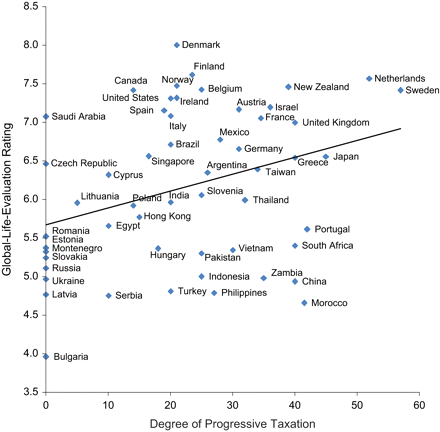
Degree of progressive taxation was defined at the difference between the highest and lowest tax rates in the country. (They calculated some other more complex indexes of progressivity, but the results were the same.) As predicted, the more progressive the tax system, the greater the happiness of citizens. Depending on which measure of happiness is used, progressivity accounted for between 24% and 52% of the variation in happiness. Here is a chart showing the scatterplot with the countries labeled.


You will notice that the United States has one of the less progressive tax codes among the 54 countries. Our happiness is a bit higher than would be predicted on the basis of the overall data (as indicated by the best fit straight line). That's probably due to our higher per capita income.

The authors were also interested in why progressive taxation was related to happiness. They predicted that the effect was due to people's satisfaction with the “public and common goods” progressive taxation allows the country to provide for its citizens. Participants were asked to rate their satisfaction with seven public goods: public transportation, health care, education, housing, roads and highways, air quality, and water quality. As expected, the relationship between progressive taxation and happiness was mediated by satisfaction with public goods. That is, progressivity predicts satisfaction with public goods, and satisfaction with public goods predicts happiness. (See my earlier post on IQ and conservatism for an explanation of how mediational hypotheses are tested.)

The authors did many other analyses, too numerous to mention here. One that I found interesting was that the positive relationship between personal income and happiness was greater in countries with less progressive tax systems. That is, in a country with a less progressive tax system, like the U. S., the rich are quite a bit happier than the poor. If the tax code is more progressive, the difference in happiness between the rich and poor is not as great.

It is important to remember that these data are correlational, so we can't say that progressive taxation causes happiness. The authors note that it is possible that some variable they did not measure, such as the general level of cohesion in the society, is the cause of both progressive taxation and happiness.

This is the kind of study that I want to shout about from the rooftops. Unfortunately, the corporate media almost never report studies like this. Maybe they think they're too complicated. A more likely explanation is that the results don't support the political agenda of their owners. (Here's one exception I found. The author adopts a skeptical tone.)

All four of the remaining presidential candidates in the Elephant Party have submitted tax proposals that call for making the tax code less progressive than it is now by either replacing our current income tax system with one that is more flat, by reducing or eliminating the tax on capital gains, or both. If President Obama sticks with his plan to repeal the Bush tax cuts for people making $250,000 or more, that would make our tax code more progressive.